
*Warning there will be spoilers included in this review.
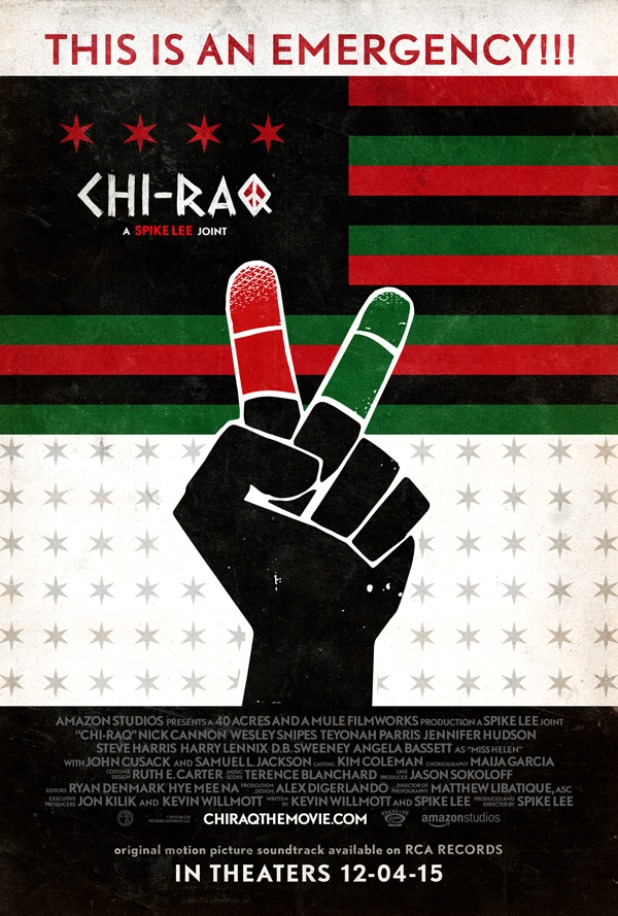
It is safe to say that the title of Spike Lee’s must recent movie Chiraq was incendiary enough to garner its fair share of attention and dually its fair share of controversy from entertainers and native Chicagoans concerned about their city and its portrayal. To say that their concern is unwarranted is to be blind to the fact that ownership of one’s story is valuable and necessary and for many Chicagoans they saw Spike Lee’s attempt at telling their story as offensive. Based off of the Greek comedy Lysistrata, Chiraq tackles a complex and controversial issue using much of the same elements used in the original story such as satire and rhyme in the dialogue. As an Atlanta native I’ll admit if I were to hear that a story of Atlanta was being made with satirical elements involved I too would initially be skeptical of the film and its message. Some would argue that this is too serious a topic to be discussed with satire, but I myself saw it as a creative way to incorporate our cultural gifts and talents all while providing the necessary comedic relief. With that being said I’ll describe the premise of the movie.
The movie opens with a chilling song rapped by Nick Canon whose character is befittingly referred to as Chiraq. Chiraq or Demetrius is the son of a well known gang member Jamel Dupree who was sent to prison when Demetrius was a boy. Chiraq opens the movie describing Chicago as he knows it, all the while asserting that he knows no Chicago only Chiraq. Demetrius is a rapper as well as the head of a local gang known as the Spartans, who are locked in an eternal battle with the Trojans who are also located on the South Side of Chicago. His women Lysistrata, is a beautiful woman in love with Demetrius but not the violence that follows them. The random killing of another innocent child in the neighborhood forces her to act though and at the suggestion of one of the woman matriarchs Sister Helen she does some research of her own. Lysistrata finds out how in Liberia Leymah Gbowee, the leader of the Women of Liberia Mass Action for Peace, managed to end the civil war that plagued their country by instituting a sex strike. Lysistrata in turn unites women from both gangs and sides together on the premise of withholding sexual advances from their male counterparts until they decided to do something about the violence. As paramount as this notion is to the movie there are several other issues that I feel have been ignored due to the initial uproar over the concept.
Spike uses the issues in Chicago as a way to speak on a myriad of issues that plague the black community such as police brutality, economic inequity and racism, all while pointing a damning figure at America and the system that supports it. But what makes his message even more compelling to me is how he still holds us as a community responsible for the issues that plague us. For instance there is a scene in the movie where our narrator Dolomedes (played by Samuel L. Jackson) juxtaposes a police officer and a gang member, stating, “Can’t trust the police, afraid of the gangs”. He continues making us think throught out the movie as a black detective stresses that there is a perception that the violence in the black community is far from damaging than the systemic attacks on black citizen’s rights and autonomy. This assertion while subtle, I say is important.
Another pivotal scene in the movie occurs when the resident preacher Mike Corrdan describes the conditions that help violence to blossom in our communities with poverty being the major point. Corridan, a pastor in the Southside neighborhood has been in the community for years, speaking out against the same injustices. He also speaks on the need for community and reminds us that solidarity against those who seek to intimidate and attack us remains our strongest weapon. He even mentions the terrorist attack that took place at Mother East A.M.E. in South Carolina, detailing the relationship between big business and gun culture. These issues were at times easily forgotten but crucial.
Despite the seriousness of the movie Spike manages to keep the tone of the mood light as the sex strikes touches on a number of issues such as the attitudes men and women hold towards sex as well as the effectiveness of withholding sex. I’ll admit before viewing the movie I too thought that Spike was asserting that withholding sex would end the violence, but after viewing the movie I left with a different outlook which I’ll share:
Women in our society and in particular the African American community hold a lot of power. They are valuable and influential and when they decide to unite on issues they are able to be very effective. The power of withholding sex while powerful in the end is not what brings the violence to the end. The collective efforts of Sister Helen’s group Mothers of the Hood in the end is what forces Chiraq to look at himself in the mirror and take blame for his role in perpetuating the violence. In my opinion this movie is one of Spike’s best pictures as he does a great job at presenting thought provoking issues in a way that is both witty and culturally accurate. In the veins of films such as Malcolm X, Do the Right Thing, and When the Leeves Broke, this film is indicative of what makes Spike Lee valuable to the black community. For older Spike Lee fans they will find relics of his patent style peppered throughout the film whether its Wake Up being shouted at the viewer or the nuisances of the camera angles. For newer fans this films properly showcases his talents as a storyteller. If nothing else though, the movie should serve as a hell of a springboard for dialogue in the community. Timely, I believe that all youth under the age of 18 should watch this movie with their parents and seek to understand how this war affects them and how they can be winners and not casualties of it.
Signed, An Anomaly

 Wright World
One reply on “Review of Spike Lee’s Chiraq”
[…] To continue reading head over to his blog here. […]